Why a plain cross
People ask why our mark is just a cross. No crest, no animal, no initials. Here is the honest answer.
The oldest shape in Europe
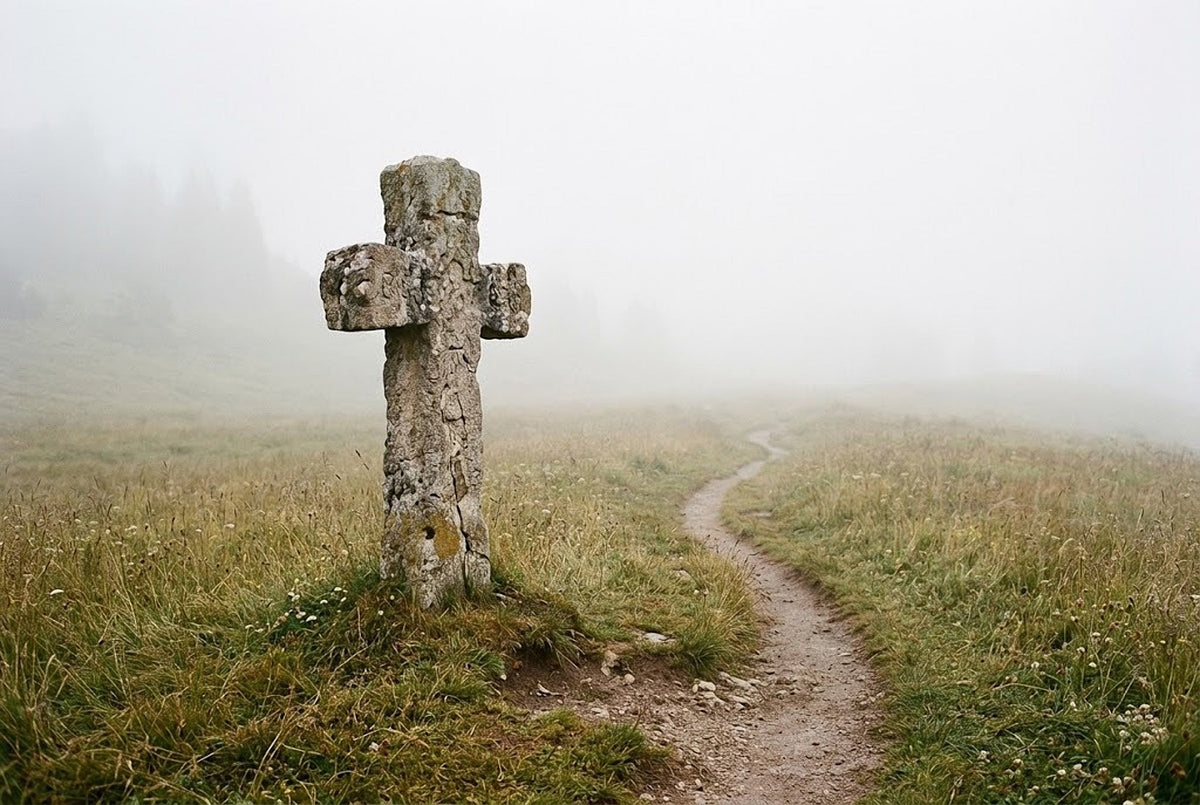
Walk any old road in Europe and you will pass one: a stone cross at a crossroads, a cross carved over a door, a cross on a mountain summit. For centuries it was how people marked a place — a waypoint, a boundary, a point you could find again. We liked that idea more than any logo we drew.
A plain Latin cross, with one detail
Our cross is the plain Latin form: a tall upright and a crossbar set high. It has one small detail most people never notice — the lower corner of the right arm is cut at 45°. It is there on every label, every patch and every embroidery. If you see the cut, you know it is ours.
A mark, not a message
We are a clothing brand, not a movement. The cross on our pieces is about where things are made to be worn — old streets, cold mornings, long walks — not about telling anyone what to think. It is a mark of origin, used quietly.
Why it stays small
On most pieces the cross is a small woven patch or a tone-on-tone embroidery. We would rather you notice the cut of a jacket first, and the mark second. The one exception is the Templar Balaclava, where the cross is the whole design.
Read more about the coordinates that go with it in 50°N · 10°E, explained.


Journal
More stories

50°N · 10°E, explained
Two numbers on every label. Where the point is, why we chose coordinates instead of a slogan, and how to read them.

Why a plain cross
No crest, no animal, no initials. Where our mark comes from, the one small cut that makes it ours, and why it...

Looking after padded and fleece pieces
Wash less, wash right. How to clean and store padded jackets, fleece, sherpa, shells, knitwear and heavy cotton so they last for...

How to layer for a cold city winter
Three light layers beat one heavy coat. A simple system for walking, waiting and warm trams — base, middle and outer, and...